
L’inglese offre una varietà di modi per esprimere il futuro, ciascuno con le sue sfumature e contesti d’uso specifici. In questo articolo esploreremo in dettaglio i principali tempi e costruzioni verbali utilizzati per parlare del futuro: il present simple, il future simple, il present continuous, il “going to”. Saranno inoltre trattati il future continuous e il future perfect.
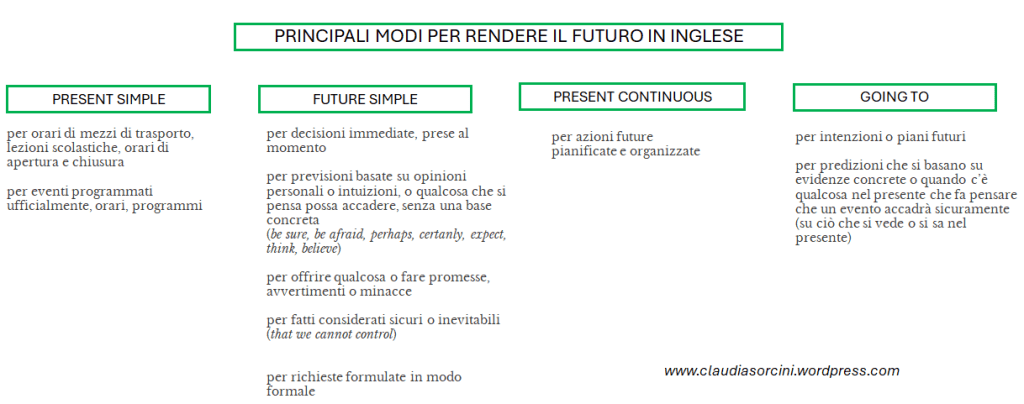
Present Simple
Il present simple si usa per esprimere eventi futuri in contesti specifici:
- orari e programmi fissi
- utilizzato per orari di mezzi di trasporto, lezioni scolastiche, orari di apertura e chiusura.
- esempi:
- The train leaves at 8 PM.
- The store opens at 9 AM tomorrow.
- eventi ufficiali e programmati
- per eventi programmati ufficialmente.
- esempi:
- The conference starts next Monday.
- The movie premieres on Friday.
- calendari e programmi personali
- per eventi personali programmati.
- esempi:
- My plane lands at 7 PM.
- The meeting begins at 10 AM.
Future Simple
Il future simple (“will” + verbo base) si usa in vari contesti:
- decisioni spontanee
- decisioni prese al momento, che non avevamo prima di cominciare a parlare e che prendiamo mentre parliamo.
- esempio:
- I’m thirsty. I will get a glass of water.
- It’s so difficult to make a choice. Ok, I’ll buy the red one.
- predizioni e opinioni personali sul futuro
- previsioni basate su opinioni o intuizioni (con i verbi expect, think, believe)
- esempio:
- I think it will rain tomorrow.
- offerte e promesse
- per offrire qualcosa o fare una promessa.
- esempi:
- I will help you with your homework.
- I will always love you.
- minacce e avvertimenti
- avvertimenti o minacce riguardanti il futuro.
- esempio:
- If you don’t study, you will fail the exam.
- fatti futuri certi
- per fatti considerati sicuri o inevitabili o fatti comuni che avverranno nel futuro.
- esempio:
- The sun will rise at 6 AM tomorrow.
- The company will open a new cinema tomorrow.
- Jerry is in Cardiff now. You won’t see him till Tuesday.
- richieste formali
- per richieste formulate in modo formale.
- esempio:
- Will you please open the window?
Present Continuous
Il present continuous (“am/is/are” + verbo-ing) si usa per parlare di piani e intenzioni già decisi:
- piani e intenzioni future
- azioni future pianificate e organizzate.
- esempio:
- I am meeting John for lunch tomorrow.
- She is flying to Paris next week.
Going to
La costruzione “going to” si utilizza per indicare ambizioni e intenzioni future (quando qualcosa è stato deciso, però non è stato ancora pianificato del tutto) e predizioni basate su evidenze presenti:
- intenzioni future
- intenzioni future, che però non sono stati ancora del tutto pianificate
- esempio:
- I am going to start a new job next month.
- I wanted to go for a walk, but I am too tired to do something today. I am going to stay at home and watch TV.
- predizioni basate su evidenze presenti
- predizioni che si basano su ciò che si vede o si sa nel presente.
- esempio:
- Look at those clouds. It is going to rain.
Future Continuous
Il future continuous (“will be” + verbo-ing) si usa per descrivere azioni che saranno in corso in un momento specifico nel futuro:
- azione in corso in un momento futuro
- descrizione di un’azione che sarà in corso in un dato momento futuro.
- esempio:
- This time tomorrow, I will be flying to New York.
- She will be studying at 8 PM.
Future Perfect
Il future perfect (“will have” + participio passato) si usa per esprimere un’azione che sarà completata entro un certo punto nel futuro:
- azione completata cntro un momento futuro
- descrizione di un’azione che sarà conclusa prima di un momento specifico.
- esempio:
- By next week, I will have finished the project.
- They will have left by the time you arrive.
 Claudia Sorcini